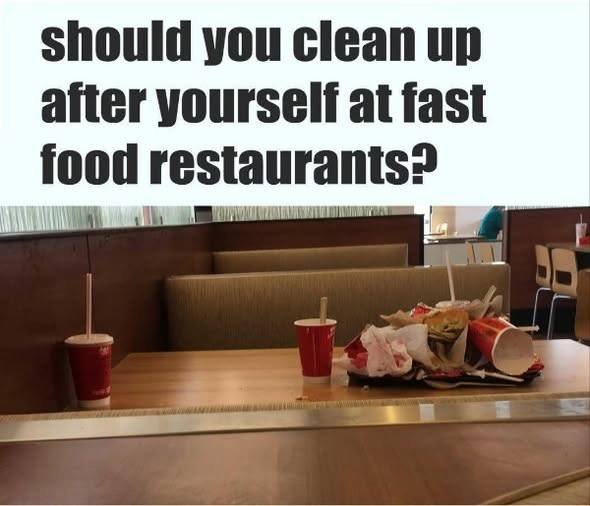
In this transactional line of thinking, the price of the meal includes the cost of the cleanup. These diners see no difference between the wrappers on their table and a smudge on the window or a scuff on the floor; all are maintenance tasks that fall under the purview of management. There is an underlying belief that the hospitality industry, even at its most “express” level, implies a certain degree of being looked after. To them, the expectation of self-clearance feels like a slow erosion of service standards—a “do-it-yourself” culture that has pushed the burden of labor onto the consumer while prices continue to rise.
However, the reality of the fast-food environment usually occupies a more nuanced middle ground. While most modern quick-service restaurants are designed with the architectural assumption that customers will dispose of their own waste, the “unspoken rule” is rarely about total sanitation. No reasonable person expects a customer to produce a spray bottle and a cloth to disinfect the laminate surface or to sweep up every stray crumb from the floor. The true point of contention is the “disaster”—the half-eaten sandwiches, the spilled dipping sauces, and the mountain of crumpled napkins that turn a dining area into a graveyard of consumption.
The table a person leaves behind is, in many ways, a mirror held up to their own social consciousness. It reflects the degree to which an individual believes their convenience should outweigh the comfort of those around them. When a table is left in a state of chaos, it creates a negative chain reaction. The next customer must either hover awkwardly waiting for a distracted staff member to notice the mess, attempt to clear the previous person’s debris themselves, or sit in a state of avoidable discomfort. This creates a friction in the social fabric that is entirely unnecessary, solved easily by thirty seconds of effort.
Furthermore, the “job creation” argument—the idea that leaving a mess ensures work for employees—is often viewed by service industry veterans as a hollow justification for laziness. In reality, most fast-food employees work with a checklist of duties that far exceeds the hours in their shift. Being forced to stop the flow of orders or the deep-cleaning of kitchens to deal with a pile of trash left by a mobile, able-bodied adult is rarely seen as a benefit to the employee’s job security. Instead, it is a source of profound frustration and a bottleneck in an industry that prizes speed and efficiency. It is a demand for a level of service that the business model was never designed to provide at its current price point.
Don’t Miss The Rest! Press Next Button Below To Continue Reading.